How to Read Food Labels for Gluten
This guide will show you how to read food labels for gluten and help you become familiar with allergen labelling in New Zealand.
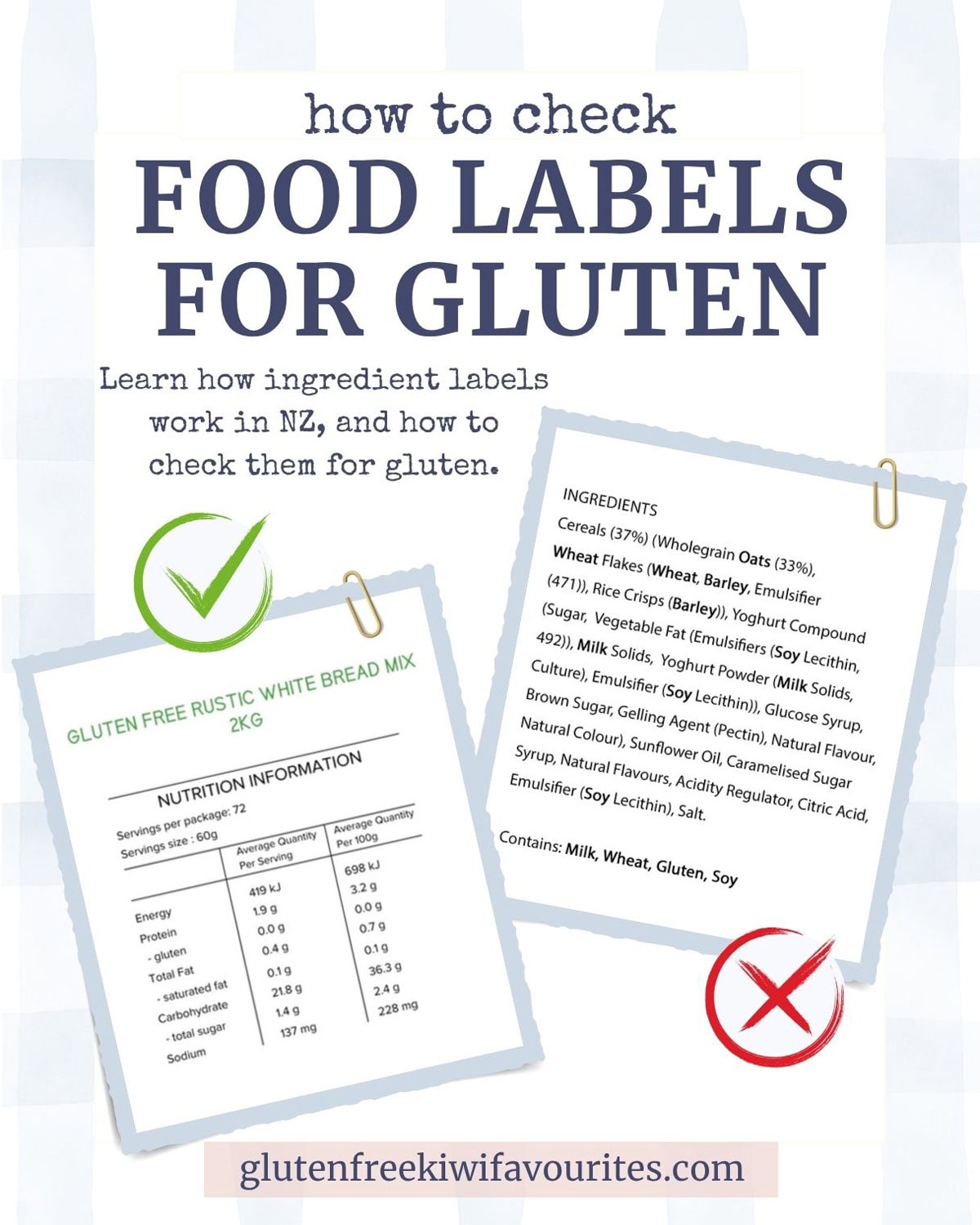
Welcome to the world of ingredient panel reading!
Look, I know, most of us don’t really want to be here. We just want to grab food, eat it, and not have to worry about what’s in it.
But here we are. We need to know what has gluten in it. And not everything we eat will have a handy “gluten free” label on it, so it’s important to know how to read food labels for gluten.
The good news is, the labelling laws we have in NZ and Australia make it simple to tell what’s gluten free, once you know where to look and what to look for 🎉
In this post, I will talk you through how ingredient labels work, what they are required to say, and what you should be looking for.
Please note:
I’m not a medical professional or a dietitian. I’m just someone who has been reading labels for gluten for 18 years, and who frequently gets asked all sorts of questions about food label-reading. So I wanted to write a guide to answer all of those in one place, in a (hopefully!) easy-to-understand way.
This guide is intended to help you understand food labels, not provide personal medical or dietary advice. As always, if you need specific advice regarding your health or diet, please have a chat with your doctor or a registered dietitian.
New Zealand food labelling rules are set by Food Standards Australia New Zealand (FSANZ).
In February 2024, new allergen labelling standards were introduced. They are “Plain English Allergen Labelling” (PEAL) and are designed to make it easier for anyone to read a product’s ingredient label and clearly see any allergens in it. This means that you do not need to memorise every single ingredient that contains gluten 🎉
Under the PEAL standards, allergens (including gluten) must be clearly declared on packaged foods unless a specific exemption applies (we’ll discuss the few exemptions below).
The main references I have used in this post are the Food Standards Code Legislation from the FSANZ website, the MPI Guide to Allergen Labelling, and the Coeliac New Zealand website.
How to Read Food Labels for Gluten
Thanks to the PEAL standards, checking a label is quite simple and should take only a few moments. I’m going to give you a quick rundown here, and then we’ll look at each step in more detail.
- First, check the food label for a gluten free claim. If it has one, great, it’s gluten free!
- If it doesn’t, the next step is to check the “contains” statement. If it doesn’t declare gluten, then it should be gluten free by ingredient.
- If it says it contains gluten, then it’s a no-go. You’ll be able to see which gluten-containing grains are present by looking at the allergens in bold in the ingredients list. Those are barley/rye/oats/wheat.
- If it declares “wheat” but not “gluten”, it may still be gluten free. This is important to remember, and I will explain why below.
- If the label seems unclear, or you’re still unsure, try a different product.
The rest of this guide breaks down these steps so you know exactly where to look, what to look for, and which labelling exceptions you need to be aware of, to help you become more confident when you’re shopping.
There’s also a handy infographic at the end that you can save to your phone.
Gluten Free Labels
First, let’s talk about products labelled as gluten-free.
For a product to be labelled gluten free, it must not contain:
- detectable* gluten; or
- oats or oat products; or
- cereals containing gluten that have been malted, or products of such cereals.
*The law states that a product must contain “no detectable gluten”. Depending on the laboratory test used, this is often described as less than 3ppm (parts per million), but the legislation itself doesn’t actually specify a ppm limit, or that lab testing is required.
(Don’t worry, you don’t need to memorise that).
If a food meets the conditions to be labelled gluten free, you will usually see the words “gluten free” on the front of the packaging, or sometimes on the back near the ingredients list. There is no set place that manufacturers are required to state it, so you’ll just have to have a look.
Nutrition Panel
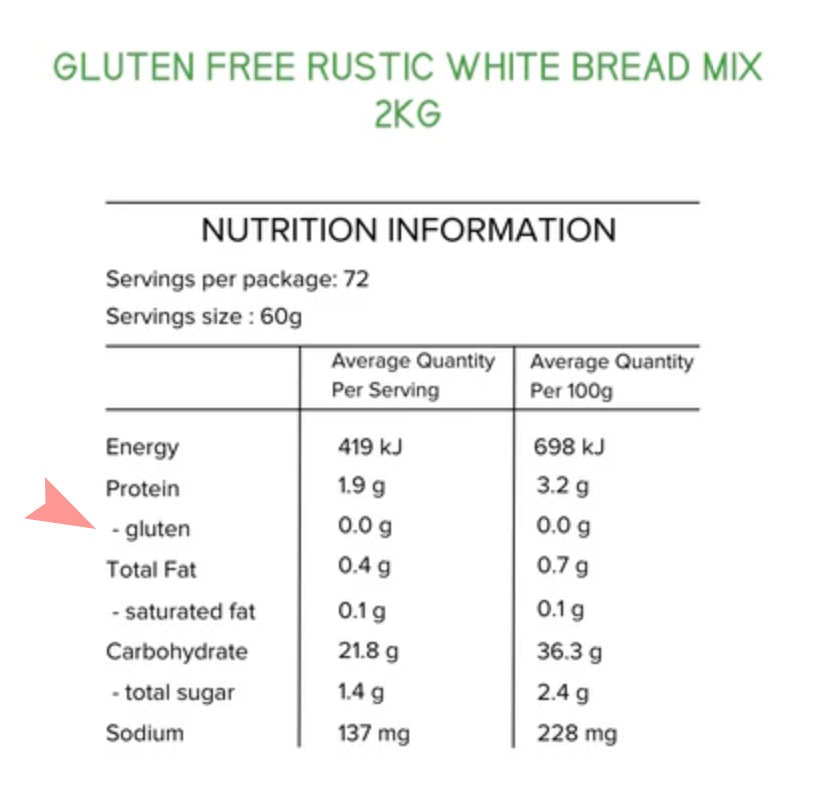
Some gluten free products list “gluten: nil detected” or “gluten – 0g” in the nutrition panel.
This example is the nutrition panel from a 2kg bag of The Alternative Bread Co. rustic white bread mix, one of my favourite gluten free, Crossed Grain approved products.
Crossed Grain Logo
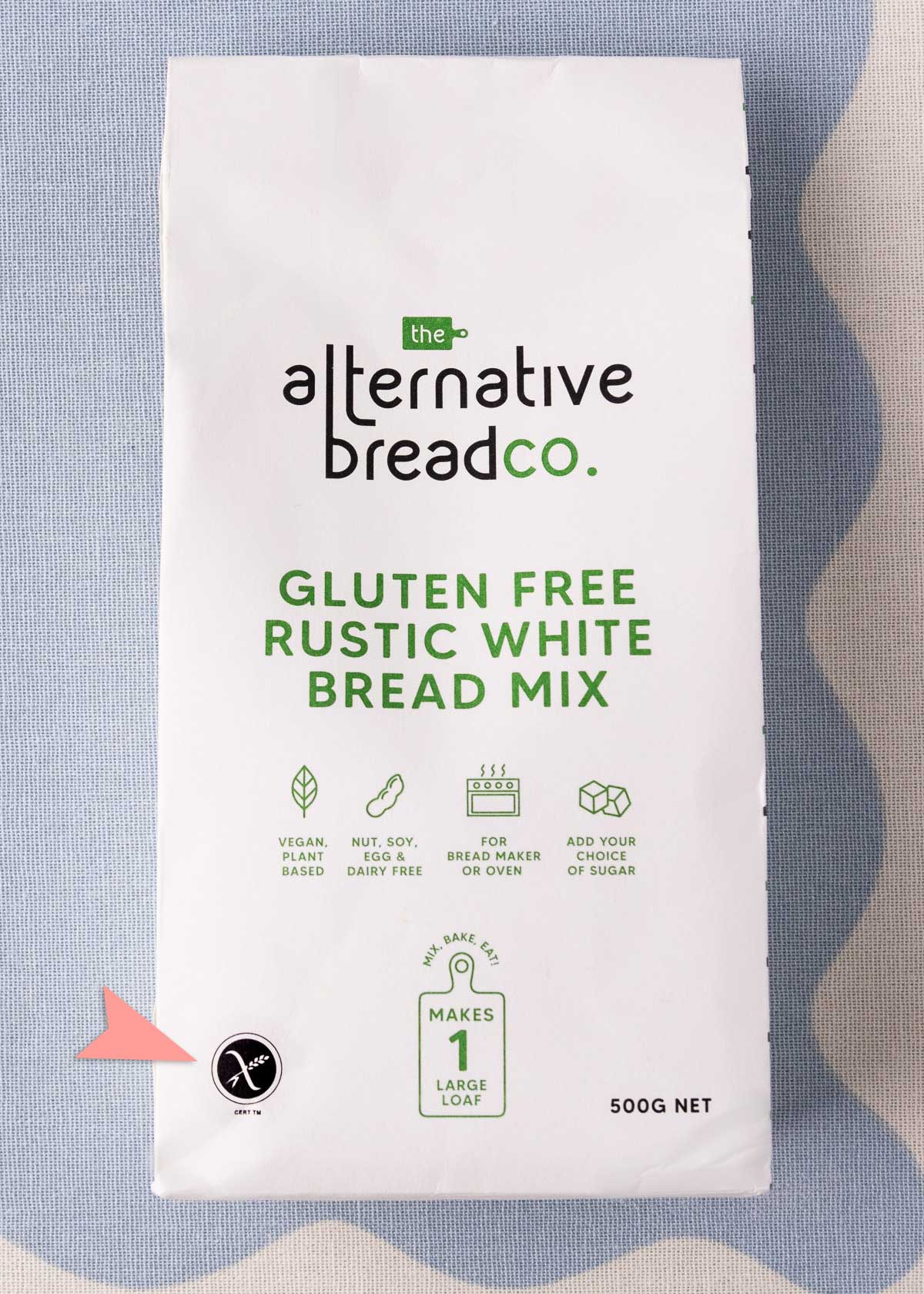
The “gold standard” of gluten-free labelling is the Crossed Grain Logo. Products displaying the logo meet the gluten-free definition outlined in the section above, have had their ingredients and manufacturing processes reviewed and approved by Coeliac New Zealand, and are subject to ongoing testing and auditing.
If a product has the Crossed Grain logo, you will usually spot it somewhere on the front of the packet.
But not all foods that don’t contain gluten are labelled gluten free. That’s why we need to check out ingredient lists.
Reading an Ingredients List
You’ll usually find the ingredients list on the back of the food packaging. It must list all of the ingredients in the product.
These are the current rules for labelling allergens on an ingredient panel:
- The font must be no smaller than the rest of the ingredients list.
- The allergen must be written using the required allergen name (this specifies exactly which allergen it is, for example wheat or barley).
- The declaration must be repeated for each ingredient that contains that allergen (if there is more than one).
- The allergen name must be in bold.
Ok, so what does that actually mean, specifically when we’re talking about gluten?
It means that in the ingredients list, the specific gluten-containing grain should be listed. Those grains are: barley, rye, oats and wheat.
When you see the allergen declared in the ingredient list, it may either be in bold font as a part of the ingredient name – e.g. barley malt, or in brackets next to the ingredient – e.g. malt flavouring (barley). Either way, you can clearly see that it contains barley.
Contains Statement
In addition to declaring the allergen on the ingredients list, packaged food must also include a “contains” statement for all allergens present in the product.
The ingredients list and contains statement work slightly differently – the ingredients list should tell you exactly which gluten-containing grain is used, and the contains statement simply tells you if the product contains gluten, rather than naming the specific grain.
While the full ingredient list is important to look at, I like to scan the contains statement first, as it should immediately tell you if the product contains gluten.
The statement should be easy for you to find because it’s required to begin with “contains”, be in a bold font and be directly next to (or underneath) the ingredients list.
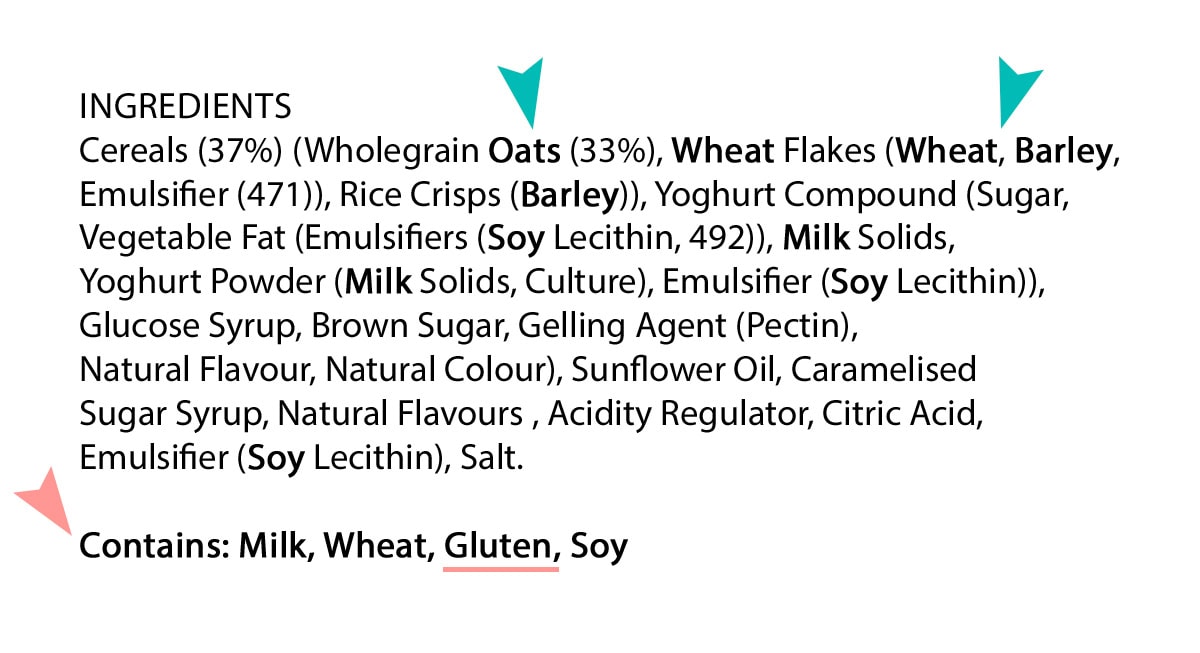
Here’s an example ingredients list of a product that contains gluten and other allergens.
First off, you can see the allergens in bold in the list (green arrows). The ones that should be jumping out to you here are barley, oats, and wheat.
Then, when we look down to the contains” statement (pink arrow), you can clearly see that this product contains gluten.
Wheat? Gluten? Or Both?
Here’s an important thing to remember, and where people often get tripped up.
Wheat and gluten must be listed as separate allergens.
This is because sometimes a product contains wheat, but not gluten.
Some ingredients contain wheat or are made from wheat, but are so highly processed that they no longer contain any gluten.
Some ingredients that are made from wheat but are considered safe for Coeliacs are:
- Glucose from wheat (this is the most common one that you’re likely to see)
- Dextrose from wheat
- Maltodextrin
- Caramel from wheat
However, some people have a wheat allergy, which is a reaction to wheat itself, not just the gluten in it. This is why wheat and gluten are listed separately as allergens.
These are the rules for declaring gluten and wheat on an ingredients label:
- If a food contains barley, oats or rye, these must be declared by name in the ingredients list, and gluten must also be declared in the “contains” statement.
- If the food contains wheat, it must declare ‘wheat’ in the ingredients list and “contains” statement.
- If gluten is present in the wheat, it must include both ‘wheat’ and ‘gluten’ in the “contains” statement.
There are some exceptions to having to declare wheat, but this post is about gluten and not wheat allergies, so I’m not going to go into that in detail here.
Long story short: if the contains statement says wheat but does not say gluten, and the product is labelled correctly, it should not contain gluten.
“May Contain” Statement
You may see an extra section on an ingredients label that states “may contain” or “may be present”. This is sometimes added to products that are processed on the same equipment as common allergens. It means the product isn’t made with those ingredients, but there may be cross-contamination during manufacturing.
Unlike the required contains statement, “may contain” is a voluntary statement that brands can choose to add to their labels.
Some brands use blanket “may contain” statements, listing every allergen they use in their production lines. This is discouraged under the PEAL guidelines. Most manufacturers clean equipment thoroughly in between producing different products, so just because one product made there contains an allergen, it doesn’t necessarily mean the rest will.
Some people are comfortable eating “may contain” products, because they are essentially “gluten-free by ingredient”, and they consider the risk to be similar to eating food made without gluten but in a kitchen that isn’t 100% gluten-free. It also opens up a wider range of “gluten free by ingredient” food options.
However, some Coeliacs, including those who have very severe reactions to traces of gluten, or those who are trying to rule out cross-contamination as a cause of ongoing symptoms, choose not to eat these products.
Some use a middle ground, where they might eat “may contain” products from certain manufacturers that they trust, but not from others.
If you need advice about whether you should or shouldn’t be eating “may contain” products, you should have a chat with your doctor or a dietician.
You can contact manufacturers to ask them to provide more information on their products. There should be contact information on the packaging.
Gluten Free by Ingredient
You may hear people say a food is “gluten free by ingredient”. This simply means the ingredients used don’t contain gluten, but the product is not labelled gluten free.
It will not list gluten in the contains statement, and it may or may not have a “may contain” gluten statement (because, as we just talked about, that’s voluntary).
Which Grains Contain Gluten?
With the PEAL standards, you don’t need to memorise the names of all the gluten-containing grains.
That said, I’m going to give you some information about them because sometimes you may come across a poorly worded ingredients panel, and if you have the background knowledge, you’ll find it easier to navigate.
“Gluten” generally refers to a group of proteins that are found in certain grains.
One of the easiest ways to remember which grains should be avoided on a gluten-free diet is to remember BROW:
B = Barley
R = Rye
O = Oats
W = Wheat
Sometimes the acronym includes an S on the end for Spelt; however, spelt is a species of wheat.
Barley is usually used as a flavouring ingredient. It is often malted (soaked, germinated and dried), and used to make things like beer and malt vinegar. It’s also used to flavour things like Milo (which, I’m sad to say, means Milo isn’t gluten free) and some cereals like cornflakes and rice bubbles (but don’t worry, there are gluten free versions of both of those!).
Rye is used as a flour in baking and is also used to flavour beer.
Oats are a tricky subject when it comes to gluten, because they don’t contain the same type of gluten as barley, rye and wheat, but they do contain a protein called avenin, which can cause a similar reaction in some people with Coeliac disease. They’re also commonly cross-contaminated with gluten. In NZ, it is not recommended for Coeliacs to eat oats.
Wheat is the most common grain used as flour in baking and is used to make most commercial baked goods. There are different types of wheat and different names that may be used, such as spelt, durum, atta, bulghur and semolina. However, as we talked about above, it must be identified as wheat on an ingredients list, and it must also declare gluten if it is present.
Additives/E-Numbers
One of the things I often see people getting confused about is food additives that are listed by their E-number, and which ones contain gluten.
But I have good news: you don’t need to learn all of these numbers and which of them contain gluten.
If the additive contains gluten, it must be declared in the same way as any other ingredient.
This is because some additives can be derived from different source ingredients. For example, an additive could be made from either wheat or corn, but the E number is the same either way. Therefore, the number on its own tells you nothing about whether it contains an allergen.
The same rules also apply if gluten is present as part of a compound ingredient or processing aid.
Also remember that some ingredients can be made from wheat but not contain gluten, and this applies to these, too.
Exemptions to Labelling Rules
The following are some products that aren’t subject to PEAL regulations.
Common Confusions
Soy / Soy Sauce
I often see people getting confused when they see a “contains soy” warning on a product, and they think that means it has gluten in it.
I think this confusion generally stems from the fact that soy sauce is usually made with wheat and generally contains gluten. However, soy (the soybean itself) does not contain gluten.
One particular type of product in NZ supermarkets that confuses a lot of people is Maggi products that contain soy sauce powder. The ingredient panel states that the powder contains wheat but not gluten, and some of the products are also labelled gluten free.
As we talked about above, a product can contain wheat but not contain gluten.
You can read more about options for soy sauce in my grocery shopping guide.
Malt
Sometimes you might see the word malt on an ingredients label and assume it contains gluten, because malted barley (or malt barley) contains gluten.
However, malt isn’t a specific ingredient; malting is a process where grains are soaked, fermented and dried.
While barley is the most common malted grain, some gluten free grains such as rice and sorghum can also be malted.
If the malt/malted ingredient contains gluten, the label must declare* it in the ingredients list and in the contains statement.
*The exception to this is in alcoholic drinks.
” The Internet Says…”
The internet is useful for a lot of things, but accurate information about food ingredients isn’t always one of them 😬
I see a lot of people saying things like, “The internet says this is gluten free, but the packet says it’s not”.
Here’s the thing: search engines, AI overviews and AI chatbots choose what information they “think” they should show you, and what they choose isn’t always the most accurate or appropriate answer.
For example, there are branded products that, when made in one country, are gluten free, but when produced in another country, they’re not. It could seem like the same product, but use completely different ingredients.
Or sometimes, ingredients for a product will change, and the search engines/AI may not catch up right away.
Likewise, supermarket websites don’t always have up-to-date allergen information on their online shopping product pages, so if you buy your groceries online, it’s a good idea to check the packets before you put them away.
There are also phone apps designed to tell you if a food is gluten free, and like supermarket websites, they mostly rely on people to input the information correctly, which may not always happen.
This is why it’s so important to become familiar with reading ingredient labels.
Mislabelled Products/Product Recalls
Now, all of this information relies on correct labelling, with every manufacturer being 100% accurate in their understanding of the rules. Unfortunately, that’s not always the case, and there is a chance you will come across one that isn’t clear or doesn’t conform to PEAL guidelines.
This can also happen with products manufactured overseas. They should have a compliant ingredient label added to the packaging if the original one doesn’t comply with our standards, but sometimes that doesn’t happen.
If you’re unsure, you can contact the company and ask for clarification. If that doesn’t help, you can contact MPI for advice, or to make a complaint about incorrect labelling.
The Coeliac Disease New Zealand Facebook group is a helpful place to ask about products you’re not sure about. Make sure to share a clear photo of the ingredients, so people can more easily help you.
Occasionally, gluten will be identified in products that don’t appear to contain gluten, or have undeclared gluten in the ingredients, in which case MPI will issue a recall of that product. You can sign up for their recall notification emails if you like.
Travelling Overseas
When travelling overseas, you may need to be a little more vigilant when reading the labels on packaged food. There are three main reasons for this:
- Other countries have different labelling requirements – they are not all required to state all allergens, and how they state them may be different to the requirements here.
- The limit for detectable gluten in gluten-free-labelled products is different in different countries. This doesn’t mean overseas products will contain more gluten than gluten free products here, and it doesn’t mean they are unsafe (they’re what the Coeliacs who live there are eating), but it’s something to keep in mind.
- Some countries allow some products made with oats to be labelled gluten free, whereas in NZ, products with oats cannot be labelled gluten free.
Before travelling, it’s a good idea to look up the gluten free rules in the country (or countries) you’re travelling to. If you’re a member of the Coeliac Disease New Zealand Facebook group, you can always ask in there for tips from people who have travelled there before.
If you’re travelling to Australia, no worries – the labelling rules for New Zealand and Australia are the same.
Many countries will allow you to take some packaged, commercially-labelled food with you, so you might want to pack some snack foods you know are safe. Check the customs rules for the countries you’re visiting first, to see what you are allowed to bring with you, and make sure you declare it when you arrive.
The Crossed Grain logo is an internationally recognisable symbol for gluten free food and is used in many countries around the world.
However, because many other countries have a higher limit for detectable gluten in gluten free products than we do in New Zealand, imported products with an overseas Crossed Grain logo can’t be sold as “gluten free” here unless they also meet our regulations.
Important Things to Remember
Having to check ingredient labels is a learning curve, and likely a big one if you’ve never had to worry about specific ingredients in your food before.
In all likelihood, you’ll accidentally buy something that contains gluten. Probably more than once. Sometimes you’ll catch it before you (or the Coeliac/gluten free person you’re feeding) eat it, and sometimes you won’t realise until after.
It doesn’t make you careless or a terrible person. We all make mistakes. And chances are, you won’t make that same mistake again. You’ll learn, get more confident, and this whole thing will feel so much less stressful.
Luckily, the new labelling rules have made this a lot easier, and after a while, reading ingredient labels becomes second nature. I promise it gets easier 💜
Label Reading Checklist
And here’s a quick checklist you can save to your phone to help you check labels while you’re shopping.
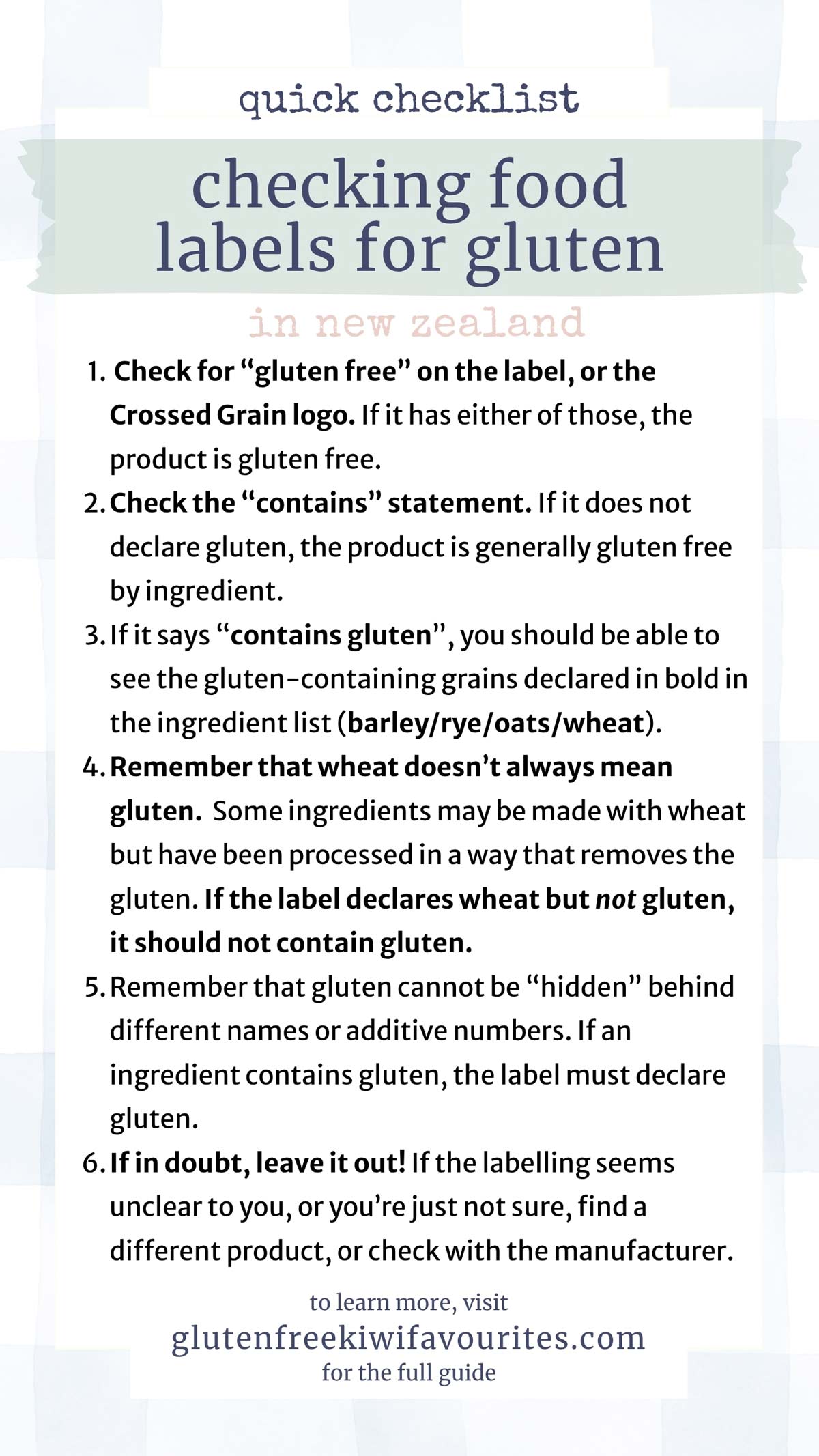
- Check for “gluten free” on the label, or the Crossed Grain logo. If it has either of those, the product is gluten free.
- Check the “contains” statement. If it does not declare gluten, the product is generally gluten free by ingredient.
- If it says “contains gluten”, you should be able to see the gluten-containing grains declared in bold in the ingredient list (barley/oats/rye/wheat).
- Remember that wheat doesn’t always mean gluten. Some ingredients may be made with wheat but have been processed in a way that removes the gluten. If the label declares wheat but not gluten, it should not contain gluten.
- Remember that gluten cannot be “hidden” behind different names or additive numbers. If an ingredient contains gluten, the label must declare gluten.
- If in doubt, leave it out! If the labelling seems unclear to you, or you’re just not sure, find a different product, or check with the manufacturer.
More Helpful Posts
- Start Guide – If you’re new to gluten-free baking, this guide will walk you through how to bake safely.
- Gluten Free Ingredients – This post talks about the gluten-free ingredients I like to keep in my pantry for baking.
- Gluten Free Product Guides – I have lists of gluten free products to help you when you’re shopping for Easter and Christmas.
- And when you’re ready to start baking, you can find all my recipes here 💜
If you have any questions or comments, let me know!